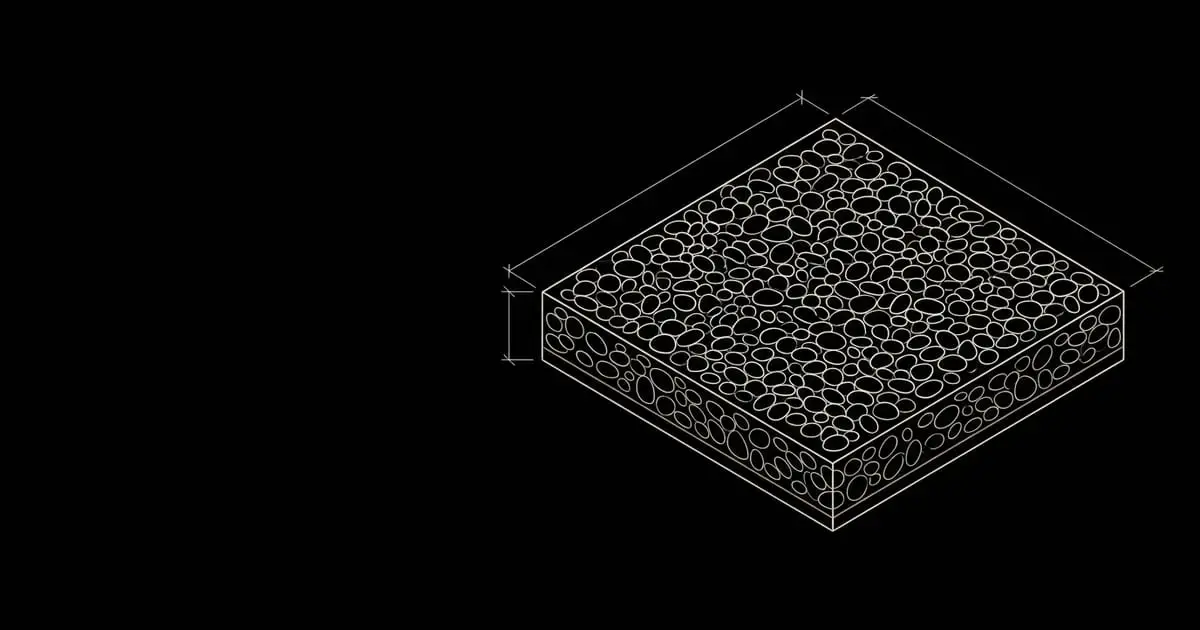
“How much pea gravel per square foot” is the quickest way to estimate a job: work out the amount for one square foot, then multiply by your area. Here’s the chart, the formula, and a few worked examples. For any shape, the pea gravel calculator does all of this at once.
The formula
Cubic feet per square foot = depth in inches ÷ 12.
Then:
- Weight: multiply by the stone weight. At 1.4 tons per cubic yard (2,800 lb), pea gravel is about 103.7 lb per cubic foot.
- Bags: divide by the bag size, often 0.5 cu ft.
- Cubic yards: divide by 27.
Pea gravel per square foot chart
At 1.4 tons per cubic yard (103.7 lb per cu ft). No extra added.
| Depth | Cu ft per sq ft | Lb per sq ft | Sq ft per 0.5 cu ft bag | Sq ft per cubic yard | Sq ft per ton |
|---|---|---|---|---|---|
| 1 in | 0.083 | 8.6 | 6 | 324 | 231 |
| 2 in | 0.167 | 17.3 | 3 | 162 | 116 |
| 3 in | 0.250 | 25.9 | 2 | 108 | 77 |
| 4 in | 0.333 | 34.6 | 1.5 | 81 | 58 |
| 6 in | 0.500 | 51.9 | 1 | 54 | 39 |
If your stone is heavier (some yards quote up to about 1.55 tons per yard, 115 lb per cu ft), the pounds go up but the cubic feet and bag counts by volume don’t change.
Worked examples
100 square feet
| Depth | Cubic feet | Cubic yards | Bags (0.5 cu ft) | Weight |
|---|---|---|---|---|
| 1 in | 8.33 | 0.31 | 17 | 0.43 tons |
| 2 in | 16.67 | 0.62 | 34 | 0.86 tons |
| 3 in | 25.00 | 0.93 | 50 | 1.30 tons |
12 × 12 ft patio at 3 inches
- Area: 144 sq ft.
- Volume: 144 × 0.25 = 36 cu ft (1.33 cubic yards).
- With 10% extra: 39.6 cu ft (1.47 cubic yards).
- Weight: about 2.05 tons.
- Bags: 80 bags of 0.5 cu ft.
Full build in pea gravel patio.
4 × 20 ft flower bed at 2 inches
- Area: 80 sq ft.
- Volume: 80 × 0.167 = 13.3 cu ft.
- With 10% extra: 14.7 cu ft, which is 30 bags of 0.5 cu ft.
Why add extra?
Real jobs need a bit more than the math says:
- Pea gravel settles a little after it’s walked on and rinsed.
- Ground is never perfectly flat; low spots take more stone.
- Some stone gets lost in edges and spills.
About 10% extra covers it. For small bag jobs, rounding up to the next whole bag often covers it already.
Depth: what to use
| Project | Depth |
|---|---|
| Garden bed | About 2 in |
| Path or patio | 2 to 3 in |
| Dog run | About 3 in |
| Driveway top layer | 3 to 4 in |
| Drainage bed | 6 in or more |
| Playground | 9 in or more |
Measuring odd shapes
- Circle: 3.1416 × (diameter ÷ 2)². A 10 ft circle is 78.5 sq ft.
- Triangle with a square corner: ½ × side A × side B.
- L-shapes: split into two rectangles and add.
The calculator handles all of these, plus rings around trees and fire pits, and adds them together.
The short version
Depth ÷ 12 = cubic feet per square foot. At 2 inches that’s 0.167 cu ft (about 17 lb), at 3 inches 0.25 cu ft (about 26 lb). Multiply by your area, add 10%, and you have your order. Or put your area into the pea gravel calculator.