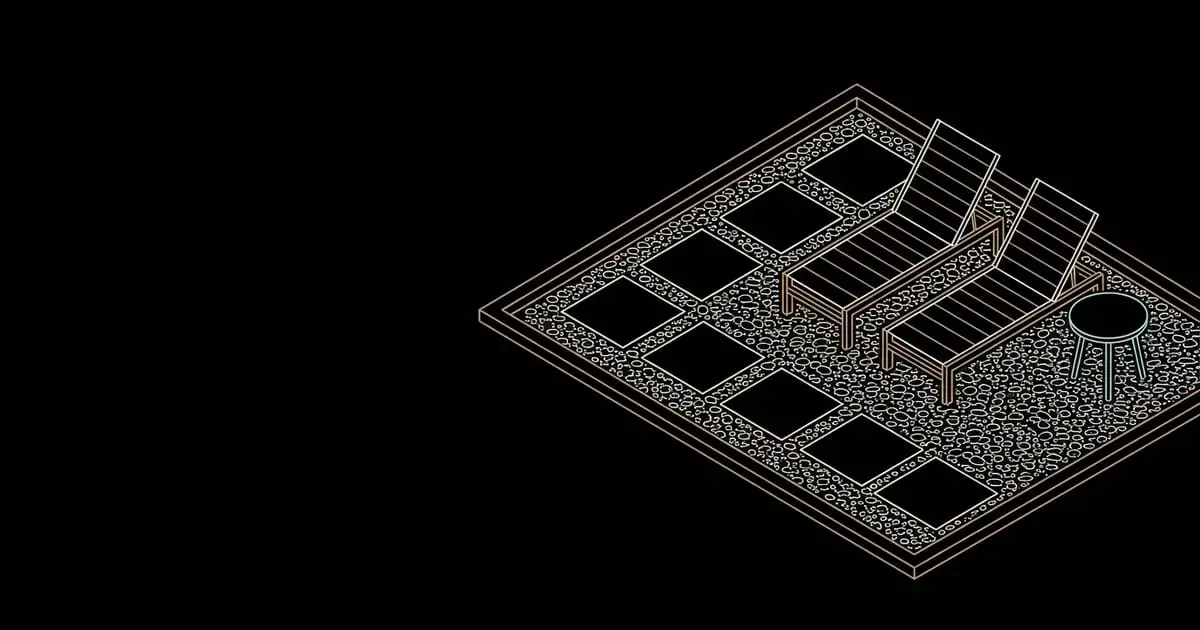
A pea gravel patio is one of the cheapest outdoor floors you can build yourself. There is no mixing, no cutting and no cure time: you dig, lay a base, add edging and pour stone. The parts people get wrong are the depth and the amount, so this guide puts real numbers on both. For your exact size, the pea gravel calculator does the math with your measurements.
How deep should a pea gravel patio be?
Aim for 2 to 3 inches of pea gravel on top of a firm base. Pea gravel is round, so it rolls under your feet. A thin layer locks together over a hard base and walks well; a thick layer behaves like sand.
| Layer | Depth | Job |
|---|---|---|
| Pea gravel (top) | 2 to 3 in | The surface you see and walk on |
| Crushed stone base | 3 to 4 in, compacted | Carries the load, stops ruts |
| Landscape fabric | One layer, seams overlapped | Keeps stone out of the soil, slows weeds |
| Subgrade | Dug out and tamped | Firm, sloped slightly away from the house |
On well-drained, firm soil some people skip the crushed stone and put 3 inches of pea gravel straight on fabric. It works for a light-use sitting area, but chairs sink more and the surface stays looser.
How much pea gravel for a patio
The formula is: cubic yards = length (ft) × width (ft) × depth (in) ÷ 324. Add about 10% for settling and uneven ground.
| Patio size | Depth | Cubic yards (+10%) | Tons (at 1.4 t/yd³) | Bags of 0.5 cu ft |
|---|---|---|---|---|
| 10 × 20 ft | 2 in | 1.36 | 1.90 | 74 |
| 12 × 12 ft | 3 in | 1.47 | 2.05 | 80 |
| 16 × 20 ft | 3 in | 3.26 | 4.56 | 176 |
Worked example: 12 × 12 ft patio
- Area: 12 × 12 = 144 sq ft.
- Volume at 3 inches: 144 × 3 ÷ 12 = 36 cu ft, which is 36 ÷ 27 = 1.33 cubic yards.
- Add 10%: 1.33 × 1.1 = 1.47 cubic yards (39.6 cu ft).
- Weight: 1.47 × 1.4 = about 2.05 tons.
- Bags: 39.6 ÷ 0.5 = 79.2, so 80 bags.
Eighty bags is a lot of trips in a car. At this size, a bulk delivery of 1.5 yards from a landscape yard is usually cheaper and much less work. Enter both prices in step 3 of the calculator to compare.
Don’t forget the base: 3 to 4 inches of crushed stone under the same 144 sq ft is another 1.3 to 1.8 cubic yards.
How to build a pea gravel patio
- Mark the shape with stakes and string or a garden hose for curves. Measure it and run the numbers.
- Dig out the sod and soil to the total depth of base plus gravel, about 5 to 7 inches. Slope the bottom slightly away from the house so rain drains off.
- Tamp the soil with a hand tamper or plate compactor.
- Install edging around the outside. Steel, aluminum, plastic paver edging, brick or stone all work. The edging should sit about half an inch above the finished gravel so stone doesn’t spill onto the lawn. See gravel edging ideas.
- Lay landscape fabric, overlapping seams by about 6 inches and running it up the inside of the edging. More on that in landscape fabric under gravel.
- Add and compact the base: 3 to 4 inches of crushed stone with fines, in two lifts, compacting each.
- Spread the pea gravel to 2 to 3 inches with a landscape rake. Hose it down to wash off dust and let it settle, then top up low spots.
Pros and cons
| Pros | Cons |
|---|---|
| Cheap compared with pavers or concrete | Stone migrates onto lawns and into the house |
| DIY friendly, no special tools | Chairs and heels sink in loose spots |
| Drains well, no puddles | Hard to shovel snow off |
| Easy to change or extend later | Leaves and debris need a leaf blower, not a broom |
| Soft, crunchy look that suits cottage and modern gardens | Not wheelchair or stroller friendly |
Ways to make it better
- Pavers or stepping stones in the gravel. A path of large pavers through the patio gives firm footing where people walk most, and you need less gravel. Measure the gravel areas only, or add the pavers as a separate shape and subtract.
- Stabilizer. A pea gravel glue or a honeycomb stabilizer grid under the stone keeps it from rolling, which helps chairs.
- A fire pit. Pea gravel is a popular surface around fire pits. Use the ring shape in the calculator for the area around a round pit. Details in pea gravel fire pit area.
Common mistakes
- Too deep. Four or five inches of pea gravel on a patio feels like a beach. Keep it to 3 inches or less and put the rest of the depth into the base.
- No edging. Without a border the stone spreads into the lawn within a season.
- Ordering by guesswork. Most yards sell by the ton, and pea gravel weight varies. Ask how many tons they load per yard, then enter it as a custom weight in the calculator.
- Skipping the slope. A dead-flat patio next to the house sends water toward the foundation.
The short version
Dig 5 to 7 inches, add edging, fabric and a compacted crushed-stone base, then finish with 2 to 3 inches of pea gravel. For a 12x12 patio, order about 1.5 cubic yards of pea gravel. For any other shape or size, put your numbers into the pea gravel calculator.