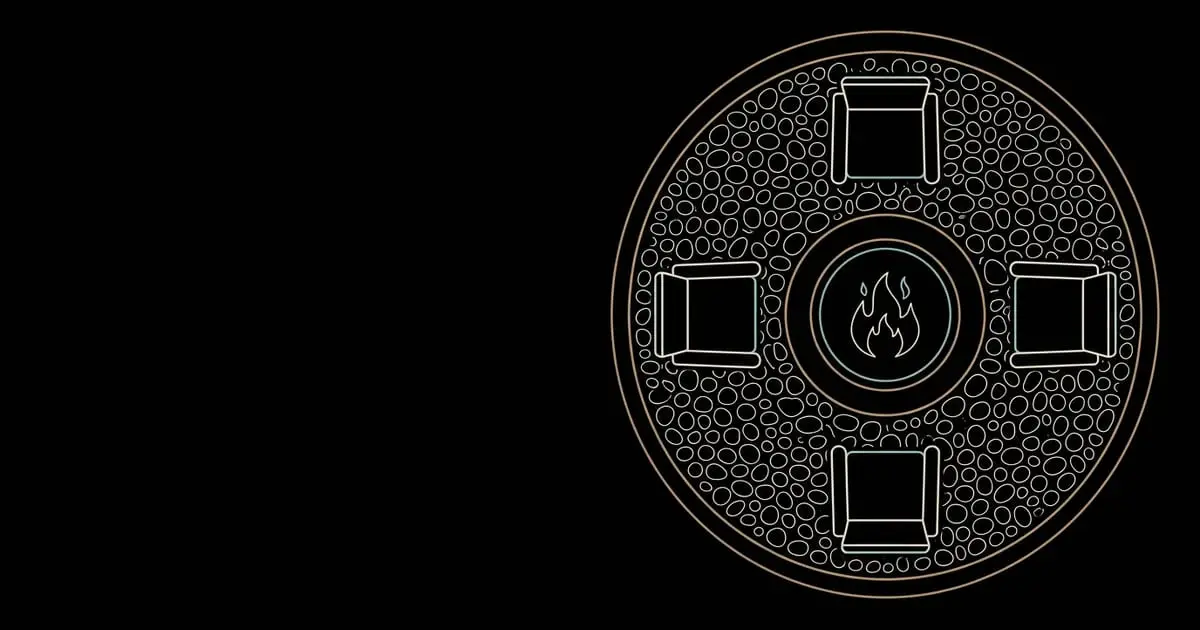
Pea gravel is one of the most popular surfaces around a backyard fire pit. It doesn’t burn, it drains, it’s cheap and it looks relaxed. The one real question people ask is safety, so we’ll cover that first, then the build and the numbers. For your own layout, the ring shape in the pea gravel calculator measures the area around a round pit for you.
Will pea gravel explode in a fire pit?
The worry comes from a real effect: some stones hold water in pores and cracks, and when they heat up fast, that water turns to steam and can crack the stone or make it pop. River rock and stones that sit wet are the usual culprits.
That matters inside the fire, not around it. So:
- Around the pit: pea gravel is fine. It won’t burn, and embers that land on it go out.
- Inside the fire bowl: don’t fill it with pea gravel or river rock. Use what the fire pit maker recommends, often lava rock or fire glass, or a bare steel bowl with a sand base.
Also check local rules on open fires and the distance from your house, trees and fences, which vary a lot by town.
Round or square?
| Layout | Shape in the calculator | Best for |
|---|---|---|
| Round area around a round pit | Ring (outer and inner diameter) | Classic look, chairs in a circle |
| Square or rectangular patio | Rectangle, then subtract the pit if you like | Fits next to a lawn or deck |
| Round patio with a separate path | Ring + rectangle | Connecting to the house or garden |
The ring shape takes the outer diameter of the gravel area and the outer diameter of the fire pit itself, so you don’t pay for gravel under the pit.
How much pea gravel for a fire pit area
| Area | Depth | Cubic yards (+10%) | Tons (1.4 t/yd³) | Bags of 0.5 cu ft |
|---|---|---|---|---|
| 16 ft circle | 3 in | 2.05 | 2.87 | 111 |
| 22 ft circle around a 6 ft pit | 3 in | 3.58 | 5.02 | 194 |
| 20 × 20 ft square | 3 in | 4.07 | 5.70 | 220 |
Worked example: 22 ft circle around a 6 ft pit
- Outer area: 3.1416 × 11² = 380.1 sq ft.
- Pit area: 3.1416 × 3² = 28.3 sq ft.
- Gravel area: 380.1 − 28.3 = 351.9 sq ft.
- Volume at 3 inches: 351.9 × 3 ÷ 12 = 88 cu ft (3.26 cubic yards).
- Add 10%: 3.58 cubic yards, about 5 tons.
The calculator link has these exact numbers loaded. It also shows the edging length, here about 88 ft because a ring has two edges (around the outside and around the pit).
How to build a pea gravel fire pit area
- Place the pit with clearance from structures and overhanging branches.
- Mark the circle with a stake at the center and a string the length of the radius. Spray paint the line.
- Dig out sod and soil 3 to 4 inches deep (deeper if you add a crushed-stone base). Keep it level, with a slight fall away from the pit.
- Install edging around the outside. Flexible steel or plastic edging makes an easy circle; stone or brick suits rustic pits. See gravel edging ideas.
- Lay landscape fabric, cutting a hole for the pit. See landscape fabric under gravel.
- Set the fire pit on a level, firm base as its maker instructs.
- Spread 2 to 3 inches of pea gravel, rake level and rinse.
Ideas
- Adirondack chairs on pavers. Set a paver under each chair’s feet so they don’t sink.
- A ring of larger stones around the pit edge to keep gravel back from the heat.
- Contrasting colors: dark pit, light gravel, or the other way round. See pea gravel colors.
- A gravel path from the house to the pit. See pea gravel walkway.
Common mistakes
- Gravel inside the fire bowl.
- Too small an area, so chairs end up half on the lawn.
- No edging, so stone creeps into the grass you mow.
- Leaves left in the gravel. Blow them out before each fire.
The short version
Pea gravel is a safe, popular surface around a fire pit, at 2 to 3 inches deep over fabric with edging. Keep it out of the fire itself. A 16 ft circle needs about 2 cubic yards; measure your own with the ring option in the pea gravel calculator.