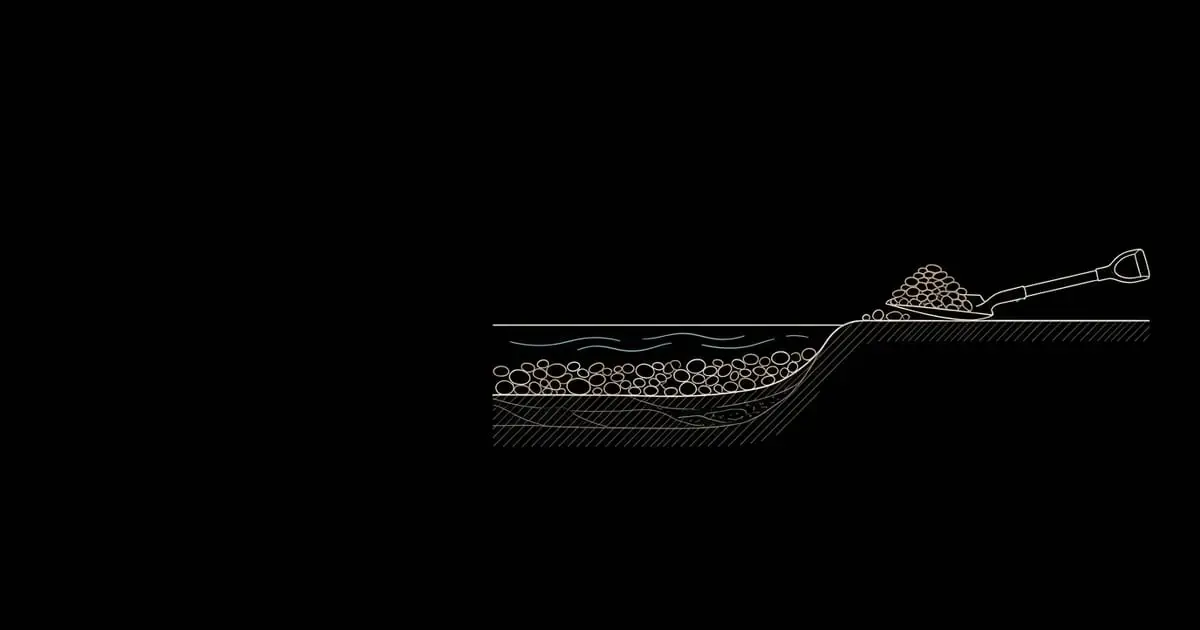
Pea gravel is one of the most common landscape stones in the US. If you’re planning a path, a patio or a dog run, you’ll come across it in every guide. Here’s what it is, what it’s good for, and how it’s sold. When you’re ready to buy, the pea gravel calculator turns your measurements into yards, tons or bags.
What pea gravel is
Pea gravel is small natural stone that has been rounded smooth by water, then dug from river and glacial deposits, washed and screened to size. The name comes from the size: most pebbles are about the size of a pea.
| Property | Typical |
|---|---|
| Size | About 3/8 in (10 mm), also sold in 1/4 in and 1/2 in versions |
| Shape | Rounded, smooth |
| Colors | Mixed tan, brown, gray, white, rust; single colors available |
| Weight | About 1.4 tons per cubic yard loose (2,800 lb), varies by stone |
| Sold as | 0.5 cu ft or 50 lb bags, bulk by the yard or ton, 1 yd³ bulk bags |
More on sizes in what size is pea gravel and colors in pea gravel colors.
What pea gravel is used for
| Use | Typical depth | Guide |
|---|---|---|
| Patios | 2 to 3 in over a base | Pea gravel patio |
| Walkways | 2 to 3 in | Pea gravel walkway |
| Fire pit areas | 2 to 3 in | Fire pit area |
| Dog runs | About 3 in | Dog run |
| Playgrounds | 9 in or more | Playground |
| Driveways (top layer) | 3 to 4 in over crushed stone | Driveway |
| Drainage | 6 in or more | Drainage |
| Garden beds | About 2 in | Landscaping ideas |
Pros and cons
| Pros | Cons |
|---|---|
| Inexpensive | Rolls underfoot if laid too deep |
| Comfortable to walk on | Migrates without edging |
| Drains very well | Weak on slopes and under tires |
| Doesn’t rot, fade or blow away | Hard to clear snow and leaves from |
| Easy DIY, easy to top up | Not wheelchair or stroller friendly |
Pea gravel vs other stone
- Crushed stone is angular and locks together, so it’s used for bases and driveways. Pea gravel is round and looser. See pea gravel vs crushed stone.
- River rock is also round but larger, used for borders and dry creek beds.
- Decomposed granite is a fine, sandy stone that packs into a firm surface.
- Marble chips are angular and bright white. See white pea gravel.
How pea gravel is sold
- Bags at home centers, often 0.5 cu ft or 50 lb. Good for small jobs. See how much does a bag of pea gravel weigh.
- Bulk by the cubic yard or ton from landscape supply yards, delivered by truck or loaded into your trailer.
- Bulk bags of about 1 cubic yard, dropped on your driveway.
One cubic yard covers 162 sq ft at 2 inches or 108 sq ft at 3 inches. That’s 54 bags of 0.5 cu ft. For bigger jobs, bulk is usually cheaper.
How to use it well
- Edge it. Every pea gravel area needs a border. See gravel edging ideas.
- Lay fabric to keep soil out and slow weeds. See landscape fabric under gravel.
- Keep it thin on surfaces you walk on: 2 to 3 inches.
- Build a base under patios and driveways.
Step-by-step in how to install pea gravel.
The short version
Pea gravel is small, round, natural stone, usually 3/8 inch, used for paths, patios, dog runs, playgrounds, beds and drainage. It’s cheap and easy to work with as long as you edge it and keep it thin. Work out your order with the pea gravel calculator.