Walk into any landscape yard and the two piles you’ll see most are pea gravel and crushed stone. They look similar from a distance and behave very differently under your feet and your car. This guide compares them and shows where each belongs. For the pea gravel part of any project, use the pea gravel calculator.
The key difference: shape
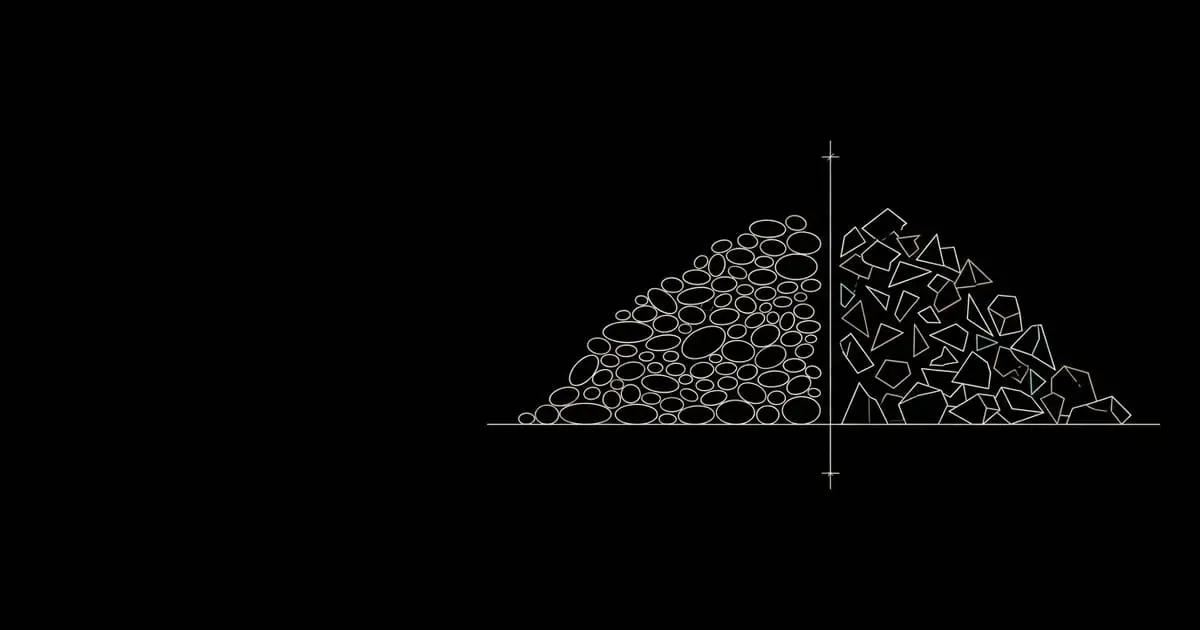
- Pea gravel is rounded by water. Round stones roll past each other, so they never lock into a solid surface.
- Crushed stone is quarried rock broken by machines. The sharp, angular faces wedge together, and with compaction it becomes a firm, stable layer.
Almost every other difference follows from that.
Side by side
| Feature | Pea gravel | Crushed stone |
|---|---|---|
| Shape | Rounded, smooth | Angular, rough |
| Stability | Shifts underfoot and under tires | Locks, compacts firm |
| Comfort barefoot | Good | Poor (sharp edges) |
| Drainage | Very good | Very good if washed; less with fines |
| Look | Soft, colorful, decorative | Gray, utilitarian (decorative types exist) |
| Slopes | Rolls downhill | Stays put better |
| Common sizes | About 3/8 in | #57 (about 1 in), 3/4 in, crusher run with fines |
Which to use for each project
| Project | Use | Why |
|---|---|---|
| Driveway base | Crushed stone | Locks and carries weight |
| Driveway surface | Crushed stone, or pea gravel over a base with a grid | Pea gravel alone ruts |
| Patio base | Crushed stone with fines | Firm, compacts well |
| Patio surface | Pea gravel | Comfortable, decorative |
| Garden path | Pea gravel (base optional) | Nice to walk on |
| Paver base | Crushed stone | Must stay flat and stable |
| French drain | Washed 3/4 in crushed stone or washed pea gravel | Both drain if washed |
| Dog run | Pea gravel | Gentle on paws |
| Playground | Pea gravel | Common loose-fill cushioning |
| Slopes | Crushed stone | Doesn’t roll |
Using both together
Many of the best gravel projects use both stones in layers:
- Fabric over the soil.
- Crushed stone base, compacted. This is the structure.
- Pea gravel top layer, 2 to 3 inches on patios and paths, 3 to 4 inches on driveways. This is the surface.
You get the firmness of crushed stone and the look and feel of pea gravel. See pea gravel patio and pea gravel driveway for full builds.
Drainage
Drainage depends on open space between stones.
- Washed pea gravel: lots of open space, drains fast.
- Washed crushed stone (like #57 or 3/4 inch clean): also drains fast and stays in place.
- Crusher run / crushed stone with fines: the dust fills gaps, so it compacts hard and drains much less. Great for a base, poor for a drain.
More in is pea gravel good for drainage.
Cost
Prices vary a lot by region. In many areas, plain gray crushed stone costs less per ton than pea gravel, and colored or decorative stones cost more than both. Since most yards sell by the ton, it also helps to know the weight per yard; ask your supplier for both stones. You can enter their figure as a custom weight in the calculator.
Working out quantities
Both stones use the same volume math: cubic yards = square feet × depth (in) ÷ 324. For a 12 × 50 ft driveway:
| Layer | Depth | Cubic yards (no extra) |
|---|---|---|
| Crushed stone base | 5 in | 9.26 |
| Pea gravel top | 3 in | 5.56 |
Order each separately, and add about 10% for compaction and settling.
The short version
Crushed stone for structure, pea gravel for the surface. Use crushed stone wherever wheels, slopes or pavers are involved, and pea gravel where people walk, sit and play. For the pea gravel layer, get your amount from the pea gravel calculator.