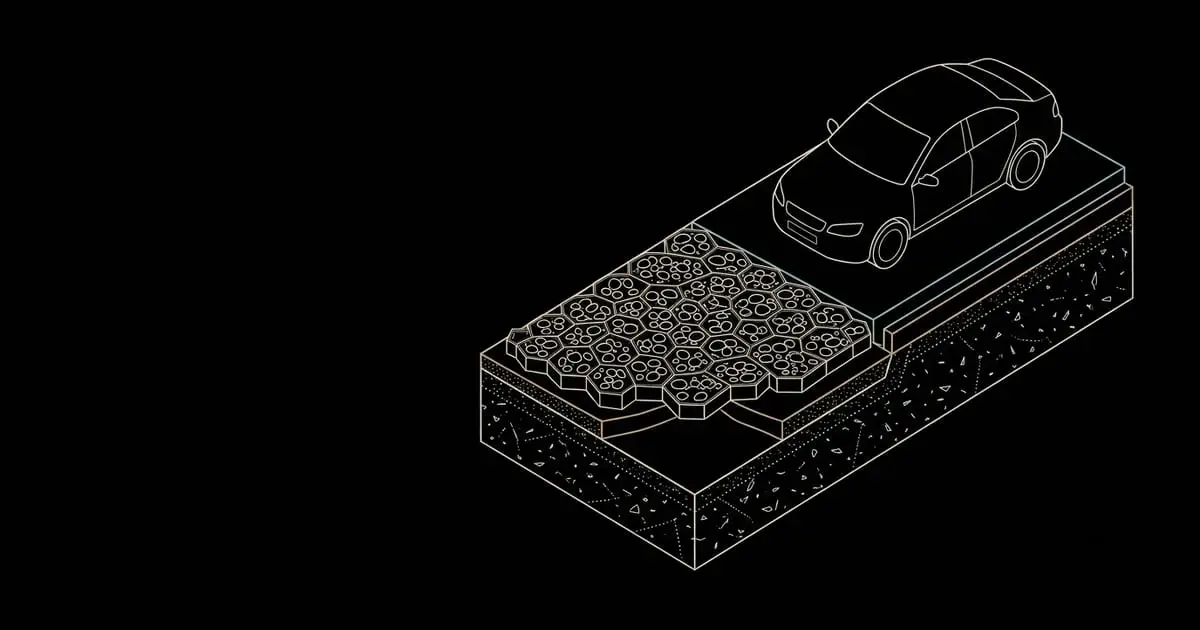
Pea gravel looks great on a driveway and it is one of the cheapest stones you can buy. It is also one of the most argued-about driveway choices, because round stones behave very differently from crushed rock under a car. Here is when it works, how to build it, and how much to order. For your own size, use the pea gravel calculator.
Is pea gravel good for a driveway?
Pea gravel is small, smooth and rounded. That is why it feels nice underfoot, and also why it struggles under tires:
- It doesn’t lock. Angular crushed stone wedges together and makes a firm surface. Round stones roll past each other.
- It ruts. Tires push stones to the sides, leaving tracks, especially where cars turn.
- It spreads. Stones get kicked onto the lawn and carried into the garage.
So the honest answer is: pea gravel works as a top dressing on a properly built driveway, not as the whole driveway.
| Pros | Cons |
|---|---|
| Low cost per ton | Ruts and shifts under turning tires |
| Drains well, no puddles on the surface | Needs edging and regular raking |
| Clean, even look | Hard to plow; snow blowers throw stones |
| Easy to top up | Not good on slopes |
How to build a pea gravel driveway that lasts
- Excavate to firm soil, removing topsoil and roots. Plan for the base plus the top layer, about 8 to 10 inches total.
- Grade for drainage, with a slight crown or slope so water runs off to the sides.
- Lay a geotextile fabric (a driveway-grade woven fabric) to keep the base from sinking into the soil.
- Build the base: 4 to 6 inches of crushed stone with fines (often sold as crusher run, road base or #57 under a finer layer), compacted in lifts with a plate compactor.
- Add a stabilizer grid (optional but recommended). Plastic honeycomb panels laid on the base and filled with pea gravel stop the stones from rolling and rutting.
- Install edging strong enough for a driveway: steel, concrete curbs or pavers set in concrete. See gravel edging ideas.
- Spread 3 to 4 inches of pea gravel and rake it level.
How much pea gravel for a driveway
Cubic yards = length × width × depth (in) ÷ 324. Landscape yards usually sell driveway amounts by the ton, so multiply by the stone weight, about 1.4 tons per yard for loose dry pea gravel.
| Driveway | Depth | Cubic yards (+10%) | Tons (1.4 t/yd³) | Bulk order |
|---|---|---|---|---|
| 10 × 40 ft | 3 in | 4.07 | 5.70 | 4.5 yd³ |
| 12 × 50 ft | 4 in | 8.15 | 11.41 | 8.5 yd³ |
| 24 × 40 ft (two cars) | 4 in | 13.04 | 18.25 | 13.5 yd³ |
Worked example: 12 × 50 ft at 4 inches
- Area: 12 × 50 = 600 sq ft.
- Volume: 600 × 4 ÷ 12 = 200 cu ft = 7.41 cubic yards.
- Add 10%: 8.15 cubic yards.
- Weight: 8.15 × 1.4 = 11.4 tons.
That is 440 bags of 0.5 cu ft, so this is always a bulk delivery. Ask the yard what one yard of their pea gravel weighs and enter it as a custom weight, because a heavier stone (1.55 tons per yard) would make the same job 12.6 tons. The calculator also compares price per ton plus delivery.
Remember the base is a separate order. Five inches of crushed stone under the same driveway is about 9.3 more cubic yards before extra.
Pea gravel vs crushed stone for a driveway
| Feature | Pea gravel | Crushed stone (#57, crusher run) |
|---|---|---|
| Shape | Round, smooth | Angular, rough |
| Under tires | Shifts and ruts | Locks into a firm surface |
| Drainage | Very good | Good (crusher run drains less because of fines) |
| Look | Soft, colorful | Gray, utilitarian |
| Best role | Decorative top layer | Base and wearing surface |
More detail in pea gravel vs crushed stone.
Upkeep
- Rake ruts and tire tracks back level every few weeks.
- Top up with a little fresh stone each year where it thins.
- Keep edging tight so stones stay on the drive.
- Snow: set plow blades or snow blower skids high, or you’ll throw gravel onto the lawn.
Glue binders that work on patios don’t survive turning tires for long. On driveways, a grid is the better way to keep stones in place. See pea gravel glue for where binders do make sense.
The short version
Use pea gravel only as a 3 to 4 inch top layer over a compacted crushed-stone base, with solid edging and ideally a grid. A 12x50 ft driveway at 4 inches needs about 8 to 8.5 cubic yards, or 11 to 12 tons. Get your exact order from the pea gravel calculator.