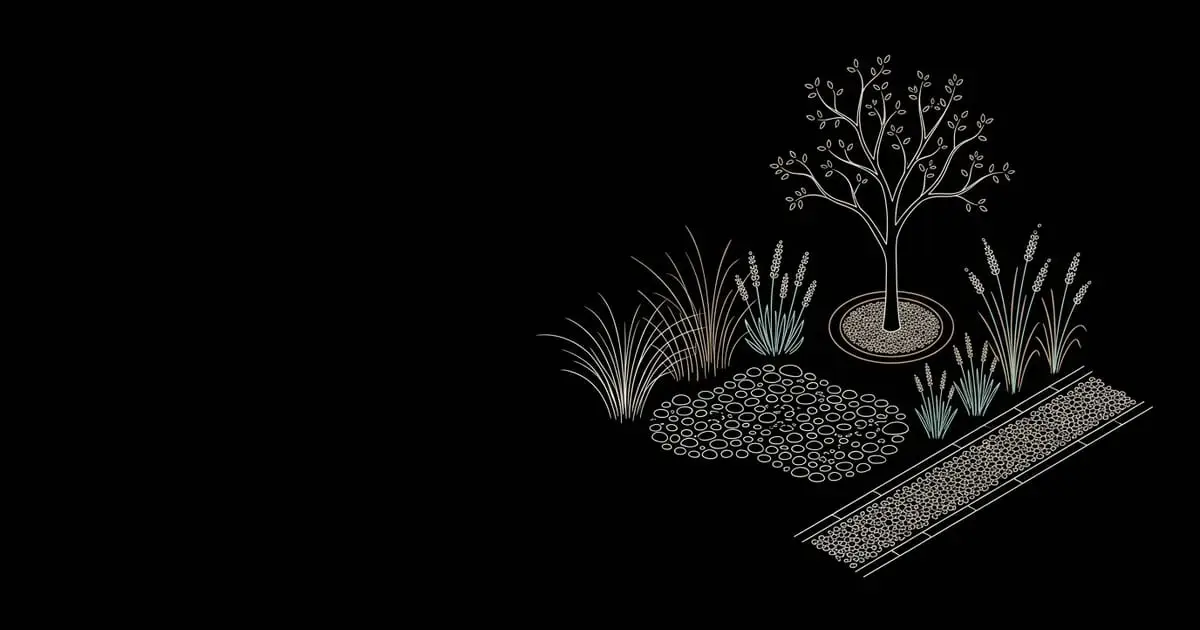
Pea gravel is the most flexible stone in the landscape aisle. It’s cheap, it comes in several colors, and it fits almost any style, from cottage garden to modern minimal. It also has a few places where it causes more trouble than it solves. Here are ideas that work, the depth for each, and where to use something else. Every project here can be measured in the pea gravel calculator.
Where pea gravel works
| Project | Depth | Notes | Guide |
|---|---|---|---|
| Garden paths | 2 to 3 in | Edging both sides | Walkway |
| Small patios | 2 to 3 in | Over a compacted base | Patio |
| Fire pit areas | 2 to 3 in | Non-flammable surface | Fire pit |
| Side yards | 2 to 3 in | Replaces patchy grass | This page |
| Dog runs | About 3 in | Base and slope matter | Dog run |
| Garden beds (mulch) | About 2 in | For plants that like dry soil | This page |
| Drainage beds | 6 in or more | Washed stone, fabric | Drainage |
| Between pavers | Fill the joints | Pavers set first | Walkway |
Pea gravel landscaping ideas
1. A side yard with no mowing
Narrow side yards rarely grow good grass. Replace it with 2 to 3 inches of pea gravel over fabric, edge it, and add a stepping-stone path down the middle for the trash cans.
2. Gravel garden with dry-loving plants
Lavender, sedum, ornamental grasses, rosemary and many perennials from dry climates grow well with pea gravel around them. The gravel reflects heat, keeps the crowns dry and looks tidy. This style suits sunny, well-drained spots.
3. Tree rings
A ring of gravel around a tree keeps the mower and trimmer off the trunk. Use the ring shape in the calculator: the outer diameter of the ring and the trunk diameter. Keep gravel a few inches away from the bark.
4. Stepping stones in gravel
Large flagstones or concrete pavers set in pea gravel give firm footing and a softer look than a solid patio.
5. Gravel sitting area
A small circle of pea gravel with two chairs at the back of the garden, edged in steel or brick. A 10 ft circle at 2 inches is only about 13 cubic feet, or 27 bags of 0.5 cu ft before extra.
6. Color contrast
Use white pea gravel against dark mulch or a dark house, or black stone with green planting for a modern look. More in pea gravel colors.
Where pea gravel is a bad fit
- Slopes. Round stones roll downhill. Use crushed stone, terraces or a stabilizer grid.
- Next to a lawn without a border. Stones end up in the mower.
- Heavy traffic without a base. It ruts and gets deep in spots.
- Driveways on their own. It needs a crushed-stone base and ideally a grid. See pea gravel driveway.
- Shady, leafy spots. Leaves rot into the gravel and you’ll be blowing it out every week.
- Wheelchair, stroller or walker routes. Loose stone is hard to push through.
How much pea gravel for a landscaping project
For any area: cubic yards = square feet × depth (in) ÷ 324.
Worked example, a 300 sq ft bed at 2 inches:
- Volume: 300 × 2 ÷ 12 = 50 cu ft (1.85 cubic yards).
- Add 10%: 55 cu ft, which is 2.04 cubic yards.
- Weight: 2.04 × 1.4 = 2.85 tons, or 110 bags of 0.5 cu ft.
Most yards are a mix of shapes. Add each bed, path and circle as its own row in the calculator, and it adds them up and gives you the total edging length too.
Tips for a neat result
- Always edge it. Steel, aluminum, brick or stone. See gravel edging ideas.
- Use fabric in paths and patios. See landscape fabric under gravel.
- Rinse new gravel to wash off dust before planting around it.
- Keep it thin. 2 inches is enough for beds and most paths.
The short version
Use pea gravel for paths, small patios, fire pits, side yards, dog runs, beds and drainage, at 2 to 3 inches with edging. Avoid slopes and leafy shade. For your yard’s total, add every area to the pea gravel calculator.