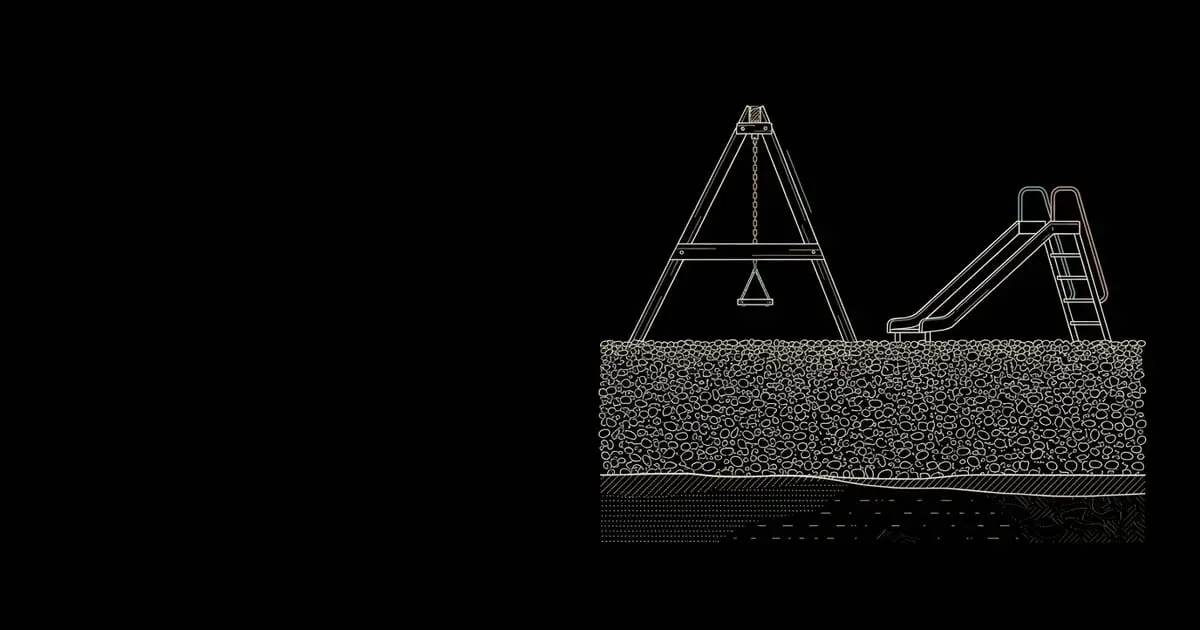
A backyard swing set or play fort needs something softer than lawn underneath it. Pea gravel is one of the most common choices because it’s cheap, drains well and doesn’t rot. The catch is depth: a playground needs far more gravel than a patio, and it’s easy to underbuy. This guide covers depth, safety and the math. For your own play area, use the playground preset in the pea gravel calculator.
How deep should pea gravel be under a playground?
Plan on at least 9 inches of pea gravel under and around the equipment, and more for taller equipment.
The reference most people use is the U.S. Consumer Product Safety Commission’s Public Playground Safety Handbook. It treats loose-fill materials like pea gravel by depth and by the height a child could fall from. It also points out that loose fill compacts and is displaced by play, so the depth you install is not the depth you keep. That’s why many people install deeper than the minimum and top it up.
What this means in practice:
- Check the handbook for the fall height of your equipment, usually the highest platform or the swing’s pivot point.
- Install deeper than the minimum so it stays above it as it settles.
- Rake gravel back under swings and slide exits, where it gets kicked out of the pits first.
This guide is not a substitute for the handbook or the equipment maker’s instructions.
Is pea gravel safe for kids?
At a proper depth, pea gravel absorbs falls much better than packed dirt or grass. Things to weigh:
| Concern | What to do |
|---|---|
| Choking risk for very young children | Many toddler play areas use other surfaces. Check the CPSC guidance for under-3s. |
| Stones thrown or carried indoors | Good edging and a mat at the exit help |
| Compaction under swings | Rake weekly in summer, top up yearly |
| Hidden debris | Rake and check the area regularly |
Pea gravel vs mulch vs sand for playgrounds
| Feature | Pea gravel | Wood mulch / chips | Sand |
|---|---|---|---|
| Rots or decomposes | No | Yes, needs replacing | No |
| Blows or washes away | Rarely | Sometimes | Yes, and attracts cats |
| Feel for small kids | Firm, stones can be thrown | Soft, warm | Soft, sticks to everything |
| Drainage | Very good | Good | Fair |
| Upkeep | Rake, top up | Top up more often | Rake, sift, cover |
There is no single best answer. Mulch is often preferred for very young children; pea gravel lasts longer and stays cleaner.
How much pea gravel for a playground
Because of the depth, playground volumes add up fast.
| Play area | Depth | Cubic yards (+10%) | Tons (1.4 t/yd³) |
|---|---|---|---|
| 12 × 12 ft | 9 in | 4.40 | 6.16 |
| 20 × 30 ft | 9 in | 18.33 | 25.67 |
| 20 × 30 ft | 12 in | 24.44 | 34.22 |
Worked example: 20 × 30 ft at 9 inches
- Area: 20 × 30 = 600 sq ft.
- Volume: 600 × 9 ÷ 12 = 450 cu ft, which is 16.67 cubic yards.
- Add 10%: 18.33 cubic yards.
- Weight: 18.33 × 1.4 = about 25.7 tons.
That is several truckloads, so ask your supplier how much one delivery carries. The calculator rounds bulk orders up to the half yard and can compare price per ton or per yard with the delivery fee.
How big should the area be?
The play surface should extend well beyond the equipment itself (the “use zone”), especially in front of and behind swings and at the exit of slides. The CPSC handbook gives use-zone distances for each type of equipment. Measure that full area, not just the footprint of the play set.
How to install pea gravel under a playground
- Mark the use zone around the equipment.
- Dig out 4 to 6 inches if you want the gravel surface flush with the lawn, or build up with tall edging.
- Install sturdy edging tall enough to hold 9 or more inches of stone: timber borders, playground curbs or landscape timbers. See gravel edging ideas.
- Lay landscape fabric or a drainage fabric to keep stones out of the soil. See landscape fabric under gravel.
- Set the equipment and anchor it as the maker instructs.
- Fill with pea gravel to your target depth, then top up after a few weeks of settling.
Wear mats under swings and at slide exits slow the hollowing out where kids land.
Upkeep
- Rake gravel back into high-wear spots weekly in the busy season.
- Check depth with a ruler at the swings and slide exits.
- Top up every year.
- Clear debris, sticks and anything sharp.
The short version
Pea gravel works under playgrounds if it is deep enough and kept that way: plan on 9 inches or more, check the CPSC handbook for your fall height, and top it up. A 20x30 ft play area needs about 18 cubic yards. Get your numbers with the playground preset in the pea gravel calculator.